
How RepChef works.
What happens behind each screen, in plain words. The numbers are here too, for when you want them.
Twelve questions. Then your plan.
Eight short screens: your body, your goal, your training, your health, your life, your food, supplements, and any fitness tests you know. Every answer changes the plan, and you see the plan before you make an account.
Nothing is asked twice. The health questions come first, before any plan is built.
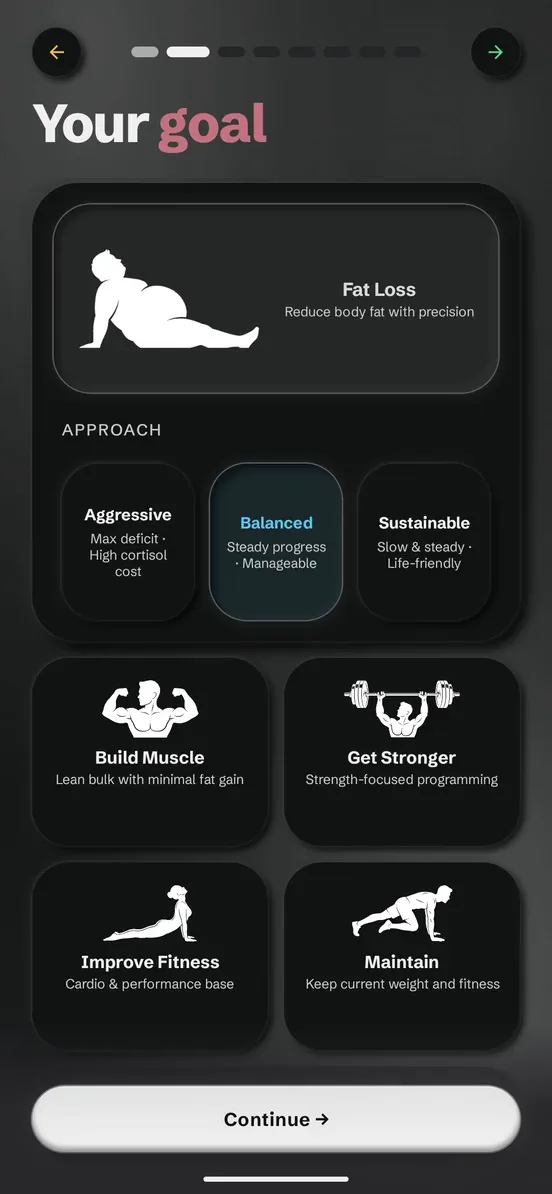
- Five goals. Lose fat, build muscle, get stronger, get fitter or maintain. Losing fat? Choose how fast: sustainable, balanced or aggressive.
- Your level. Beginner (under a year of training) to elite (five years or more). It decides how hard week one can be.
- Your kit. A full gym, or whatever you have at home: bodyweight, dumbbells, bands, a pull-up bar, kettlebells.
- Your sport. Add your sport and how often and how long you play, and the calories count toward your day. In season? There's a mode for that.
- Your food. Diet styles from vegetarian to keto and halal, the allergens you avoid, the cuisines you eat, two to six meals a day.
Your numbers, worked out for you.
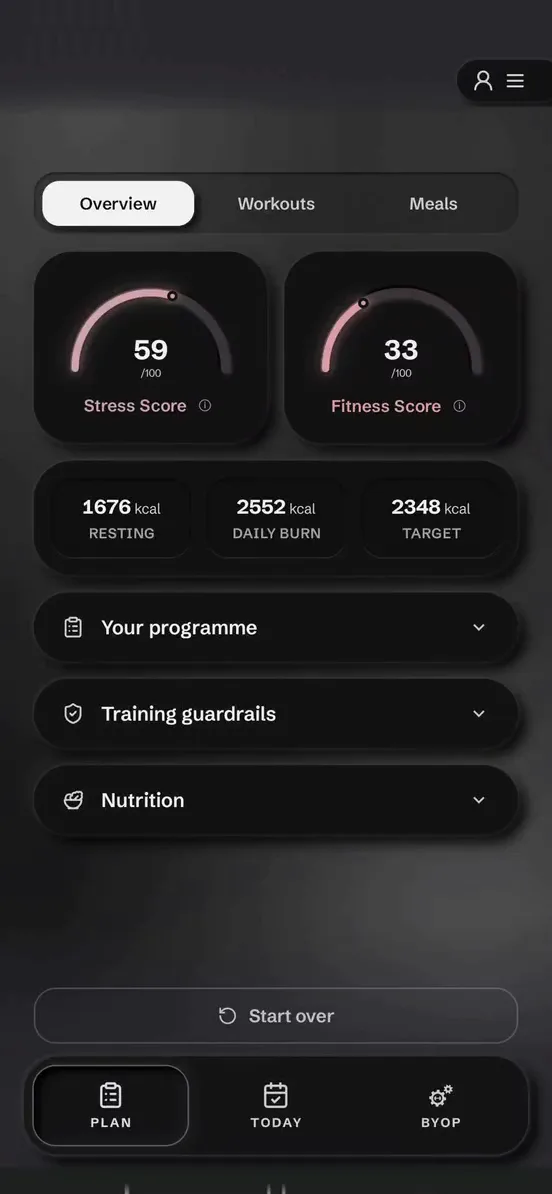
Your calories start from published, peer-reviewed formulas: Mifflin-St Jeor for most people, Katch-McArdle if you know your body fat, Schofield if you're under 18 or over 65. Every formula is an estimate; your weekly check-in is what corrects it.
Then it adds your training, your job, your steps and your stress. Your target sits a little under what you burn, and never more than a quarter under.
- A capped deficit. At most 25% of what you burn, whatever your goal or pace.
- A calorie floor. Your daily target never drops below a set minimum, whatever you ask for.
- Enough protein. 1.6 to 2.0 g per kilo of bodyweight, set by your goal. Plus fibre: 14 g per 1,000 kcal.
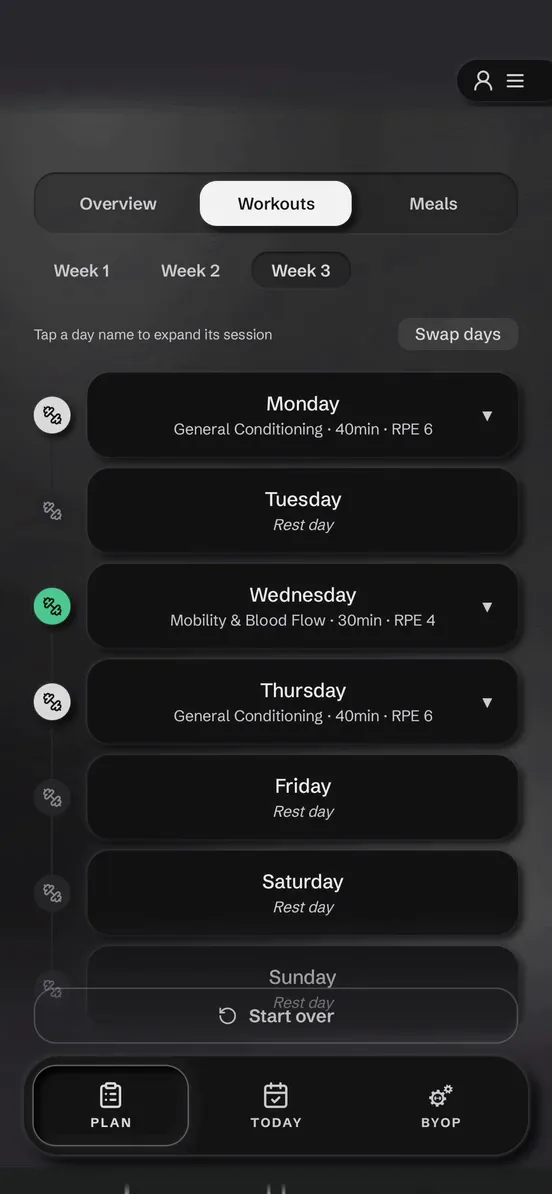
- Rest built in. Training days, rest days and easy recovery days, all named in your week.
- Same answers, same plan. Calculated, not written. No AI writes your plan, and no smartwatch is needed.
A bad week changes the plan.
Six things you told it add up to a stress score: sleep hours, sleep quality, how stressful your job is, how much you train, how much processed food you eat, and caffeine. Your sport adds to it, up to 25 points.
The higher the score, the gentler the week. It's our own model, not a medical test, and your weekly check-in keeps correcting it.
- Five levels. Optimal, mild, moderate, high, critical.
- How much work. Full at optimal. Half at critical.
- Hard sessions. Three a week at optimal. None at critical.
- Deficit cap. 700 kcal at optimal. 100 kcal at critical, whatever your goal says.
- Training days. Six at optimal. Three at critical.
Today, and only today.
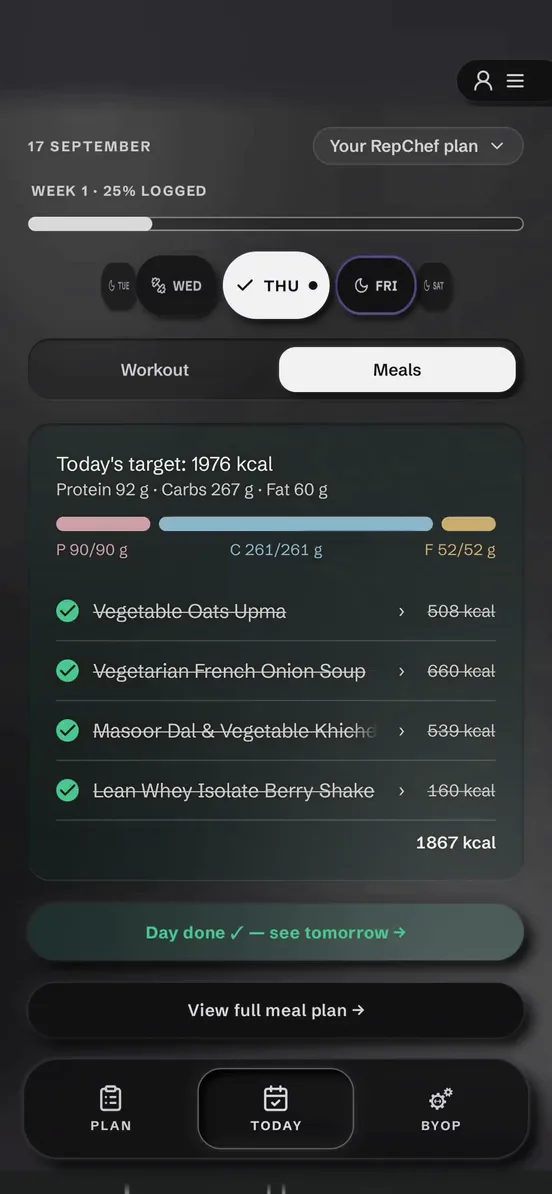
Your workout on one tab, your meals on the other, your weight if you want to log it. Tick a set. Tick a dish. Nothing else to fill in.
Workout logged and every meal ticked? The day's done and tomorrow lights up. No streaks, no badges, no confetti.
- No skipping ahead. You can't tick tomorrow. The plan is for today.
- Rest days are rest. A rest day shows rest, and your meals to tick.
- Free on every plan. Logging, ticking and your weight cost nothing, and a plan you have stays readable and loggable if a subscription ends.
Every week, it checks back.
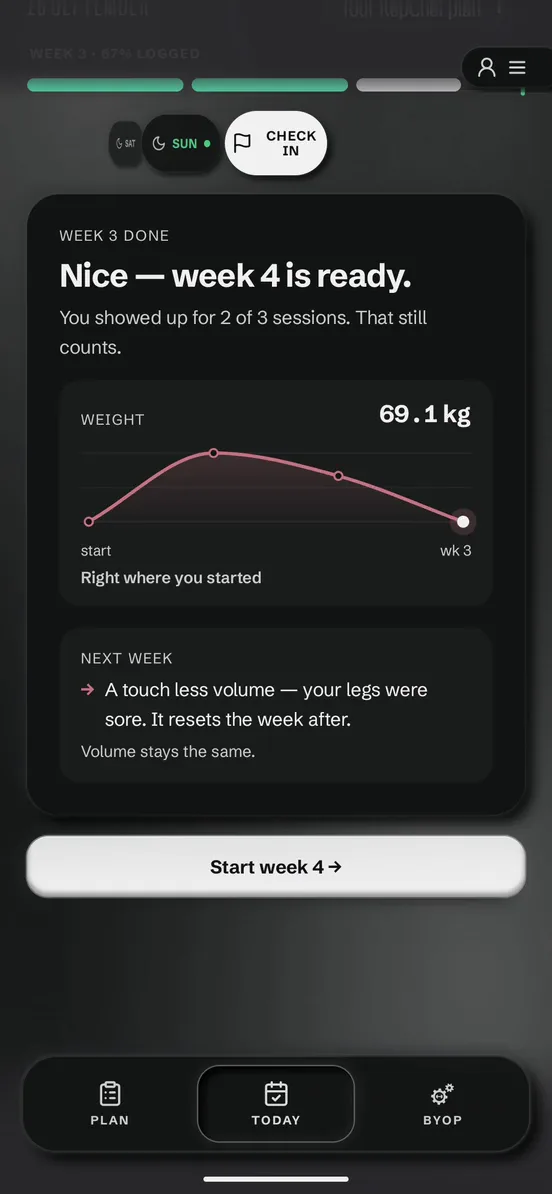
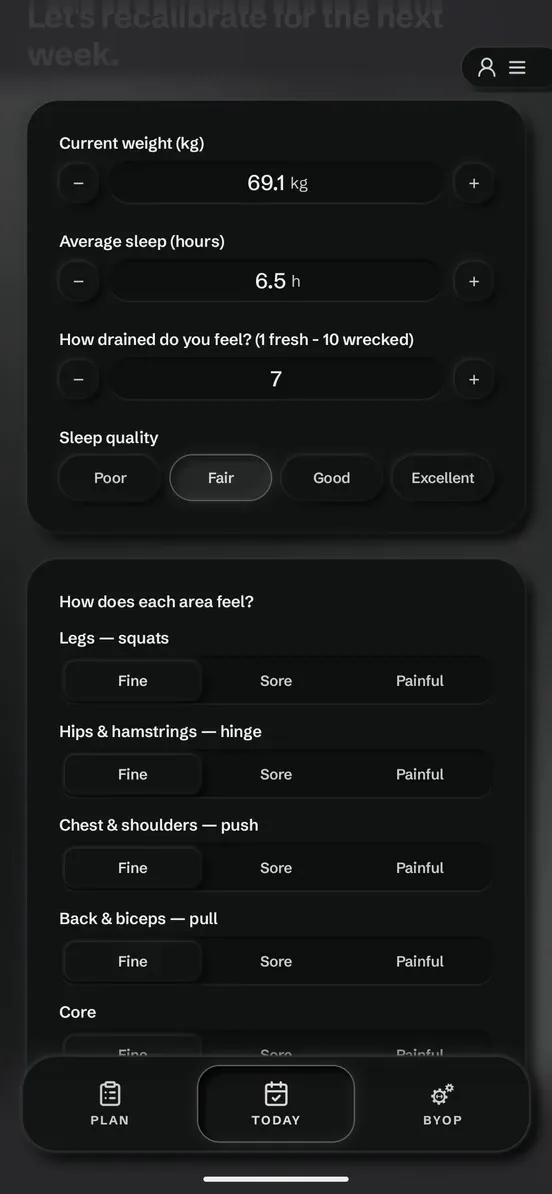
At the end of the week, or once every session is logged, the check-in opens: weight, sleep, how drained you feel from 1 to 10, sleep quality, anything sore, and optional strength tests. It can't be opened early.
Your answers run through a fixed set of checks, and next week is built from what they find. Sometimes that means less. That's the point.
- Weight stuck. It trims another 100 kcal.
- Weight dropping too fast. It gives you 150 kcal back.
- Strength stuck. Weights come down 10% so you can build back up.
- Feeling wrecked. One training day fewer and 10% less work.
- Sore somewhere. 5% less work for that area, up to 15% in total.
- Skipped a lot. 10% less work, so next week is one you'll actually do.
- Every fourth week. An easy week: 40% less work, on purpose, so your body catches up.
- Stress changed. The whole week is rebuilt at your new level.
- The limits. Never less than half the work, never fewer than two training days, and the deficit never turns into a surplus.
- Start the next week. One tap builds it. On the free week the check-in is saved; building the next week for you needs Adaptive, RepChef Pro or Trainer Studio.
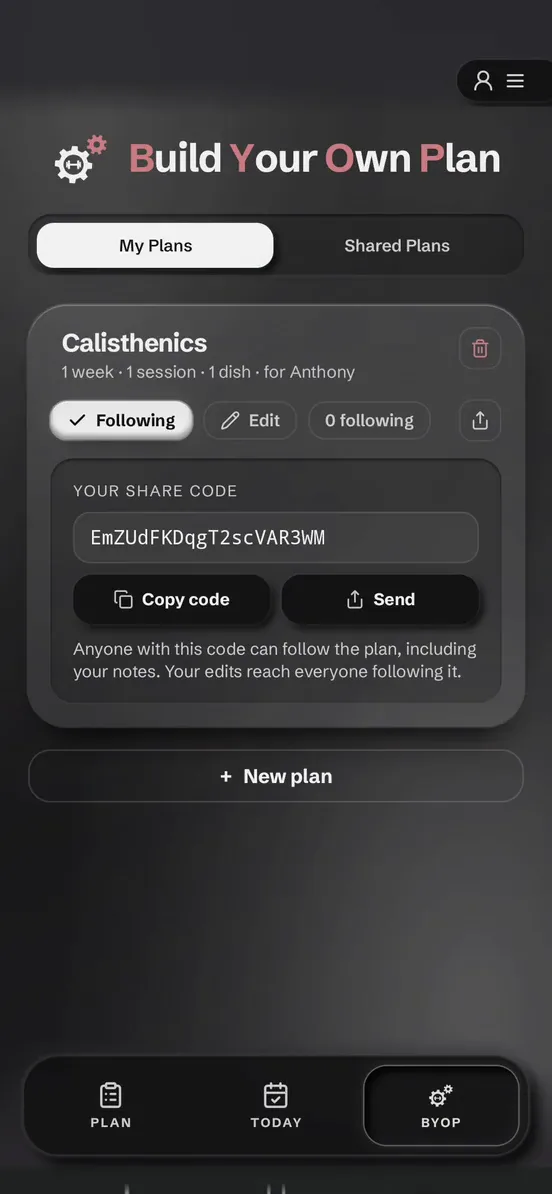
Build your own. Share it with one code.
Everything the engine uses is yours to build with: the whole library of moves and dishes, plus your own dishes on any paid plan. Seven days, a workout tab and a meals tab, an Add button on every day. Missing a move? Type it in.
Follow it like any other plan.
- Sharing a copy. One code, on every plan, with anyone. Whoever enters it gets their own copy: your days, moves, sets, reps, rest and meals, to change as they like. Never your weight or your numbers.
- Sharing live. Your changes reach their phone as you make them. Try it with one person on any plan; for clients, it's Trainer Studio.
- Free. Up to three plans of your own, each one week that repeats, so you can keep logging as long as you like.
- On a paid plan. Meals and your own dishes in every plan you build. Tracker and RepChef Pro: as many plans and weeks as you like. Adaptive: up to 3 plans, each one week that repeats. Trainer Studio: your clients' plans too.
Real dishes. The maths is done.
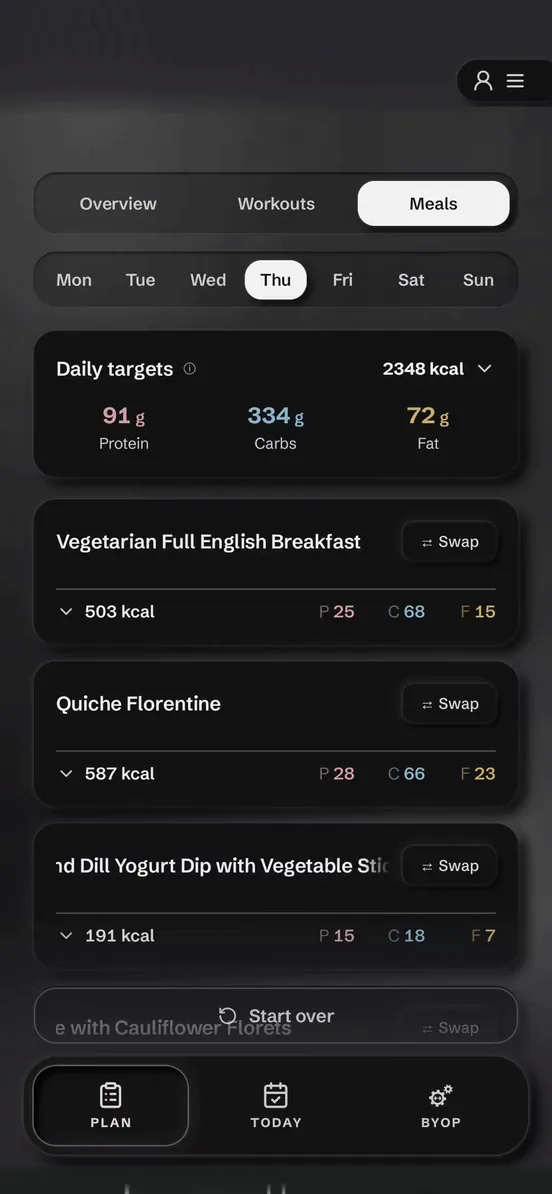
Meals are dishes, not grams to chase: a large library of dishes, picked so each day lands on its calories, protein, carbs and fat. Veg, vegan, keto, halal and more, in the cuisines you eat, as many meals a day as you like.
Your allergens are kept out when your week is built. Allergy and medical swaps are free on every plan.
- No repeats in a day. The same dish never shows up twice in one day.
- Your diet style. Only dishes that fit it are ever picked.
- Your cuisines. The plan leans toward the ones you chose.
- Check the label. We pick the dishes. What's in the packet is still yours to check.
Health questions come first.
Before any plan: three standard health questions (the PAR-Q most gyms use), seven movement checks and a question about pain. Chest pain at rest means no plan is built, and that rule lives on our server, not in the app. Chest pain during exercise, or dizziness, brings up a warning you have to read and accept.
The 25% limit and the calorie floors hold, whatever you ask for. RepChef is guidance, not medical advice. A coach, doctor or dietitian is still the person to ask.
- Three health questions. Heart trouble, chest pain, dizziness.
- Seven movement checks. Joints and movements that need care before you add weight.
- Pain. Where it hurts and what it stops you doing. Sore areas get lighter work.
- The limits hold. No goal can override the deficit cap or the calorie floors.
What's free.
Logging, ticking, your weight and the weekly check-in are free on every plan. A subscription adds more, and a plan you already have stays readable if it ends.
Subscriptions are bought in the app through Google Play, which shows the price in your currency.
- Free. Your first week built for you, and up to three plans of your own that repeat each week, with copies to share.
- Adaptive, the main plan. Plans from us, week after week, rebuilt after each check-in, with meals and your own dishes in up to 3 plans you build.
- Tracker. Build your own plans from our moves and dishes or your own, or just track; meals, your own dishes, as many plans as you like.
- RepChef Pro and Trainer Studio. RepChef Pro is both. Trainer Studio adds client onboarding, plan sharing and tracking for 10 to 50 clients, with 14 days free to try.